
On Preserving Australian Liberties
KY CAO
Ky Cao is an economist and former energy entrepreneur who is passionate about preserving Australian liberties.
About Ky

Energy Entrepreneurship
Ky built his career in economic consulting and power generation / retail. He was founding Managing Director of Perth Energy Pty Ltd (PE), the first private new-entrant power and gas gen-tailer in Western Australia. He grew PE from startup to $300m turnover by the time he retired in from the company in 2016. PE is now owned by AGL, the largest energy utility in Australia.
During his time at PE, the company developed a $130m, 120MW dual-fuel fast-response plant in Kwinana (2010), and a $92m, 82MW diesel peaking plant in Merredin (2012). Both plants are supplying backup services (firming capacity) to intermittent solar and wind generation on the South-West Grid.
In 2011, Ky was awarded the Ernst & Young Entrepreneur of the Year for Australia’s Western Region Services.
In 2018, Ky co-developed a $70m, 49.5MW solar farm in Quang Tri Province, Vietnam, which was successfully delivered to the Vietnam grid in 2019.

Contribution to WA Industry Reform
In 2001-05, Ky led the private sector’s lobbying efforts to deregulate the then state-owned monopoly electricity supply industry in WA. He set up and chaired the Independent Power Advisory Group (IPAG), which comprised major conglomerates with energy interests in WA. IPAG assisted the WA Government in key programs, the disaggregation of the vertically integrated utility Western Power, and introduction of the Wholesale Electricity Market (WEM) in 2006. Ky’s pioneering work is recorded in WA Parliament Hansard (36th Parliament, 2nd Session, Legislative Council, 14-08-2002).
In 2016, the University of Western Australia, Ky’s Alma Mater, established the Ky Cao Prize, awarded to the best student in the Economic Policy unit ECON3395 each year in recognition of Ky’s contribution to industry reform.

Economics Expertise
Prior to founding PE, Ky worked as professional economist at the State Energy Commission of WA and consultancy firm Syntec Economic Services in Melbourne.
In 1993, he accepted a Senior Research Fellowship at the joint UWA-Curtain-Murdoch University Asia Research Centre to lead a team of experts in the study of Asia’s emerging financial markets. Ky’s book, The Changing Capital Markets of East Asia was published in 1995 by Routledge in London and New York.
His recent book, Preserving Australian Liberties (2025) is available on Amazon.com and Amazon.com.au.

Free Market, Open Society
Ky arrived in Australia in 1979 under the Australian refugee resettlement program that helped resettle boat people from camps in South East Asia. He spent 6 months at the Liam Sing refugee camp in Thailand after a 12-day boat journey from South Vietnam.
As a first generation migrant, Ky believes deeply in Australia’s free market, open society foundations.
Only a free market open society can accord protection to each citizen and small consumer by virtue of competition among a multitude of suppliers, including suppliers of political services.
Only a free market open society can ensure we have the accuracy of information to respond to world demand and maintain competitiveness and prosperity.
Only a free market open society can ensure we have the liberty and collective wisdom to improve on the inspirations and deeds that make us who we are as citizens of a free nation.
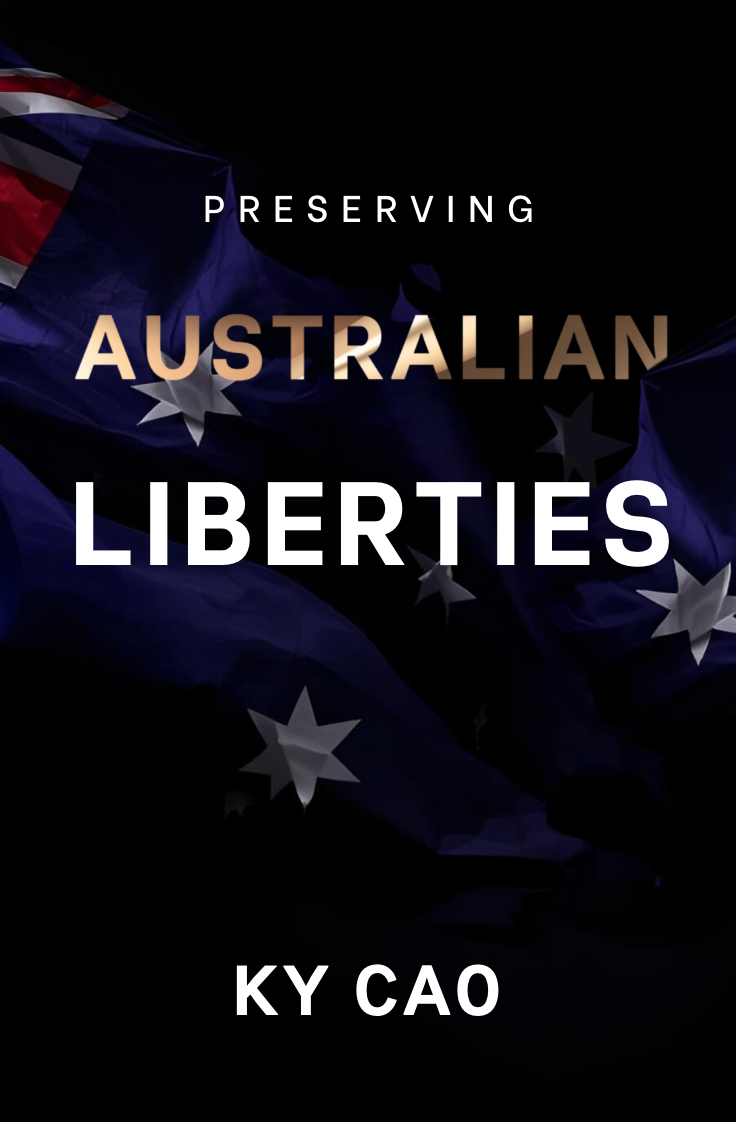
Preserving Australian
Liberties out now
State of Play
-
The road to serfdom is not due to tradition, race, social structure, or any factor that appears to be associated with the character traits of a people. It is due to deliberate adoption and absorption of an ideology, the belief system of those that carry no doubt about them being right and others wrong, that they are morally superior to those who disagree with them, and that others must submit to their views and practices lest torture or death be visited upon them. It’s the last demand and threat that usually lead to war…
READ MORE -
With successive waves of migrants, it is natural for people of the same group to coalesce around the same place for mutual support. This is a prevalent self-organising method for first generation migrants. By the time the second generation participates in the labour force, this geographic gathering dissipates quickly. This process doesn’t imply tribalism and doesn’t result in long-term entrenchment of economic ghettos. The success of multiculturalism so far has been a two-way street…
-
The stronger USD injects some dynamic portfolio management factor into central bank forex holdings but in value terms, the decline in USD share of total holdings is marginal, reflecting little movement in nominal USD shares. The U.S. economy relies less on international trade than the PRC economy. The USD is used most of the time to underwrite global trade. It is undisputedly the world reserve currency because it has the deepest capital market and U.S. Navy backing it up. It doesn’t need gold or any precious metal or asset to support its intrinsic value…
READ MORE -
The foundation for free trade is the comparative advantage principle. Assuming there are 2 countries, A and B, each producing the same 2 goods, chair and bicycle, both countries can gain from trade even if one country can produce both goods more efficiently than the other. The default benefit of trading comes from the relative efficiency between the countries in producing the goods. If the opportunity cost of producing one good is different between the countries, they will both gain from trading…
-
The world is jostling for a seat at the most competitive free market table for the first time in over half a century and the Australian government is continuing to dally with the discarded priorities. Australia is facing a record national debt of well over $1 trillion or 38% of GDP, nearly $70,000 per individual (non-business) taxpayer. The fact that some other OECD countries are carrying a higher debt-to-GDP ratio doesn’t make ours any less risky or unsustainable…
-
“Net-Zero” is not something that we can bet our entire economy on. Especially when the US, China, and India, making up two-thirds of global CO2 emissions, don’t believe in it.
We, as a nation, must approach the purported risk of Climate Change just as we would any other risk to Australia and the world—in a rational way—rather than mandating fossil fuel-free “Net-Zero” energy systems blindly.
To reach “Net-Zero” by 2030, the cost to Australians is at minimum $1.5 trillion – $54,000 for every man, woman, and child.
All this, to deal with Australia’s 1% of world emissions — meaning there is zero prospect of ‘moving the needle’ on the subject.
READ MORE -
One big contributor to CO2 is the fossil fuel-based electricity supply system around the world. In Australia, this sector’s emission reaches over 30% of total national emission. Reducing the supply chain emission of Australia’s power system is claimed to be a priority in tackling emissions nationwide. But Australia and much of the West have seen net decreases in emissions over the last decade. China is the largest net contributor to CO2 emissions and India is next as the second largest by virtue of its surging coal fired power production…
-
Unlike the glorious bipartisan reform programs of the 1980s-1990s, Australian governments in the last 20 years have not left any outstanding mark on the economy or society. The country has been living off the earnings from the market deregulation and competition programs of the past. We have only seen public policy go the wrong way, fielding a surging interventionist mode, raising the national debt, stifling the market, raising taxes to vying the top socialist spot with China’s so-called communist regime. On the back of high commodity prices, Australia has been coasting on a few years of mining revenue that spared us fiscal crises and is masking our relative decline.
-
The size of Australia’s public sector has gone from bad to worse. As of July 2024, it employed approx. 2,517,900 people according to the ABS, in a total employed workforce of 14,469,600, or 17.4%, varying by state (38% in the Australian Capital Territory, 17% in New South Wales), with public sector employment growing 3.6% in the year to June 2024 and making up 24% of all new jobs created between FY2021 and FY2025. We are producing a fake economy through our own taxes.
Estimating the public sector’s contribution to GDP is less straightforward due to varying definitions, eg, whether it includes only government spending or also state-owned enterprises and the army of contractors relying mainly on government income. The metric that analysts consider reliable is the total government final consumption expenditure as a percentage of GDP…
-
There is a saying, Government’s view of the economy could be summed up in a few short phrases – if it moves, tax it; if it keeps moving, regulate it; if it doesn’t move, subsidise it.
The records of Australian Federal Budgets in the last 20 years represent an accurate reflection of the joke. More than that, we have allowed our society to be taxed and subsidised into nigh nihilism. A merry-go-round where the not-in-need still reach in to take a bit for every circle simply because free money is offered by government in advance of elections…
-
This is a point of contention for the U.S. in its relationship with Europe. The U.S. wants European NATO to shoulder more of the alliance burden since reliance on U.S. largesse has meant the E.U. having spare resources to throw into self-harming monolithist programs like climate change and other unproductive U.N. initiatives. Picking up on the geopolitical dimensions earlier in the military positioning in the Indo-Pacific, Australia is dealing with the PRC as a regional hegemon that is on its way to rivalling the USN, at least in quantitative terms, in the Southwest Pacific…
-
Western culture was born from a historical process of development that distilled what works for humanity and what doesn’t. It has no racial or ethnic or discriminatory implications.
Democracy can be defined to varying degrees but in essence it is based on the Basic Freedoms, which guarantee free elections, free public discourse, and government by consensus. Explicit division of powers means a congress or parliament that consists of a Lower House for proposing laws and an Upper House for reviewing laws to protect society from simple majority rule, an independent judiciary that interprets laws in compliance with the Constitution, and an executive branch that implements laws by practical policies…
Have questions or want to discuss policy?
CONTACT KY
